Most assessment problems do not begin with one dramatic mistake. They usually develop from late observation, poor planning or inconsistent control. Understanding these patterns can help you practise the cause—not only the final error.
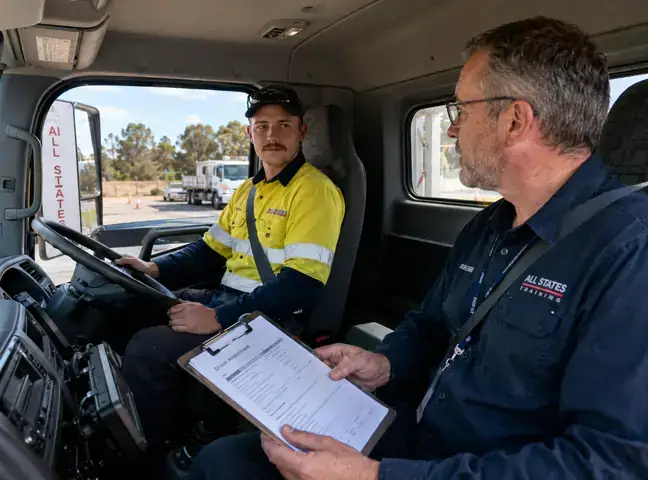
Missing mirror checks
Looking ahead is not enough in a heavy vehicle. Candidates may forget to check before braking, signalling, turning or moving sideways. The assessor needs to see a safe observation routine connected to each action.
Practise: mirror, signal, position, speed and final observation as one connected routine.
Braking too late
Late braking reduces planning time and can lead to a rushed gear change, harsh stop or poor lane position. Begin slowing early enough to keep the vehicle stable and arrive at the correct stopping point.
Incorrect speed for the situation
A candidate may be under the speed limit but still too fast for a curve, roundabout, narrow street, poor visibility or busy intersection. Select a speed that leaves time to observe and stop safely.
Poor lane positioning
Common errors include drifting towards lane lines, travelling unnecessarily wide, cutting a corner or allowing the rear wheels to strike the kerb. Use the mirrors to monitor both the front path and rear tracking.
Unsafe gap selection
A car-sized gap may not be enough for a loaded truck or long combination. Judge whether the entire vehicle can enter, turn or merge without forcing another road user to alter speed or direction.
Changing gear while turning
Trying to steer and change gear together can reduce control and observation. Complete the speed reduction and gear selection before steering input is required.
Rough accelerator, clutch or brake use
Harsh inputs can unsettle the vehicle, load and passengers. Smooth control shows that you understand the truck’s weight and response.
Incorrect steering technique
One-handed steering, palming, uncontrolled hand crossing or removing both hands can reduce control. Keep effective contact with the wheel and make smooth corrections.
Disobeying a sign or road marking
Rolling through a stop sign, entering from the wrong lane, ignoring an arrow or exceeding the speed limit can have serious assessment consequences. Scan far enough ahead to identify mandatory requirements early.
Rushing the reverse exercise
Speed is rarely helpful while reversing. Poor setup, limited mirror use and late corrections make the task harder. Stop when necessary, observe the area and use the shunts or restarts permitted for the specific assessment.
Not responding to a developing risk
An experienced driver anticipates pedestrians, vehicles emerging from side streets, changing traffic lights and vehicles entering blind areas. Do not wait until a hazard becomes an emergency.
How to reduce these mistakes
- Complete a realistic mock assessment without coaching.
- Ask for feedback under the same eight skill areas used in HR assessment.
- Practise the weakest skill separately, then place it back into normal driving.
- Do not book the assessment only because the package time has finished.
Review the class-specific guides in the Heavy Vehicle Assessment Preparation Hub.
Important: This is an educational guide. Current Transport WA requirements, your approved provider’s procedure and the assessor’s directions take priority.