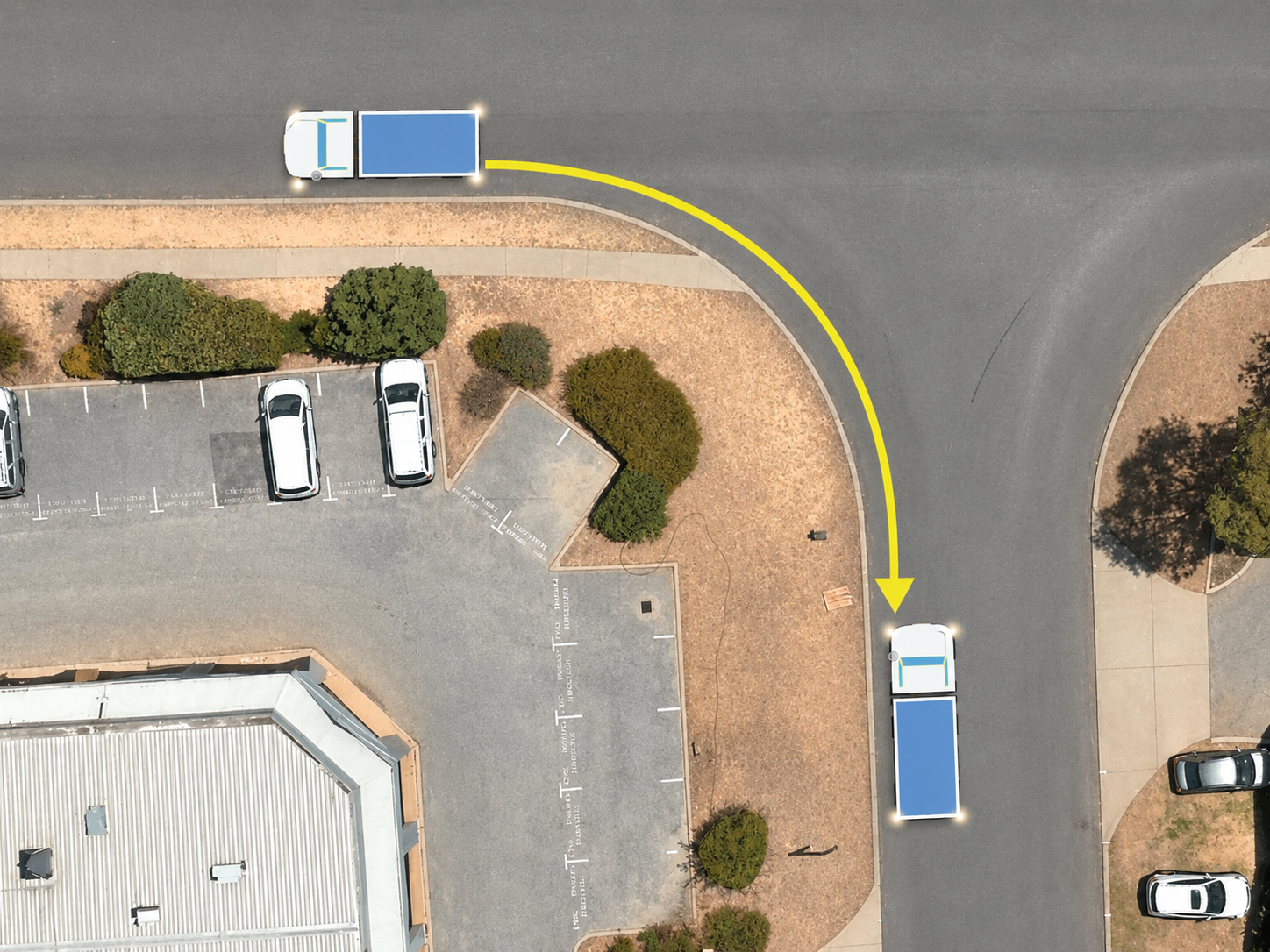
Roundabouts are difficult in a heavy vehicle because the driver must manage lane rules, traffic gaps, vehicle length and rear-wheel off-tracking at the same time. Good preparation begins well before the give-way line.
1. Read the roundabout early
Identify the intended exit, lane arrows, signs, traffic inside the roundabout, pedestrians and the available turning space. Move into the correct lane early and avoid a late lane change.
2. Choose the correct entry lane
At a multi-lane roundabout, lane arrows take priority. In general, use the left lane for an exit less than halfway around and the right lane for an exit more than halfway around. An exit approximately halfway around may be approached from a permitted lane, subject to the arrows and road layout.
3. Check mirrors before slowing
Check the mirrors, ease off the accelerator and brake progressively. Complete any necessary gear change before significant steering begins. Enter at a speed that allows you to maintain accurate position.
4. Give way correctly
WA rules require a driver entering a roundabout to give way to vehicles already within it. Select a gap large enough for the whole heavy vehicle. Do not enter if your movement would force another driver to brake or take evasive action.
5. Signal for the intended exit
- First exit: signal left on approach and continue until leaving.
- More than halfway around: signal right on approach, then signal left before leaving when practicable.
- Straight ahead: normally do not signal on approach unless lane movement requires it; signal left before leaving when practicable.
Always follow the current road layout and WA rules for lane changes and indicators.
6. Control the vehicle’s path
Look through the turn while monitoring both mirrors. The front needs enough clearance, but the rear wheels take a shorter path. An HC or MC combination also has several articulation and tracking points.
Do not swing unnecessarily into another lane. Where a long vehicle lawfully needs additional space, the movement must still be planned, signalled where required and completed safely. Other drivers may not understand what the truck is doing.
7. Use a driveable apron only when lawful and necessary
WA law allows a vehicle that is too large to pass without using the edge of a central island to use that edge when it can be done safely. Driving over the central island is only permitted where it is designed for that type of vehicle. A normal raised island or kerb is not a driving path.
8. Leave without rapid acceleration
Keep steering and speed controlled until the vehicle is established in the exit lane. Accelerating too hard while the steering is still unwinding can increase off-tracking and make a correction more difficult.
Assessment-ready routine
- Read signs and arrows.
- Choose the lane early.
- Check mirrors and signal.
- Reduce speed and select the gear.
- Give way and choose a safe gap.
- Monitor front clearance and rear tracking.
- Signal left before leaving when practicable.
- Complete the exit smoothly.
Also read HR assessment preparation for the complete vehicle-control standard.
Official reference: WA Road Traffic Code 2000, Part 9—Roundabouts.
Important: This is an educational guide. Current Transport WA requirements, your approved provider’s procedure and the assessor’s directions take priority.